

meet the grey ghost of the Himalayas
snow leopard
expedition
In India's Cold Desert Capital
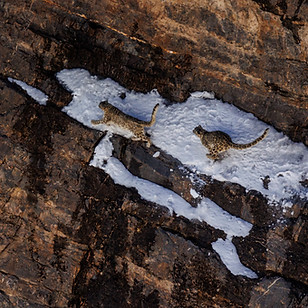
Spiti means “the middle land,” the stretch of the high Himalaya wedged between India and Tibet, where the Great Himalayan range blocks the monsoon so completely that almost no rain reaches the valley floor. At over 4,000 metres, where the Himalaya run dry and the wind is the only thing that never stops moving, lies one of the last strongholds of the snow leopard. The snow leopard has hunted these slopes for longer than any monastery has stood on them. It is built entirely for this terrain.
The cold desert atmosphere of Spiti is home to many exotic Himalayan fauna such as Snow Leopard, Himalayan or Tibetan Wolf, Red Fox, Asiatic ibex, Bharal or Blue Sheep, and many others.
Our destination in Spiti, i.e., Kibber village and the surrounding area, is a hotspot for the Snow Leopards and their prey base. Kibber is at an altitude of 14200 ft, and the village is famous for hosting tourists during winters for Snow Leopard watching. Kibber and Chicham village are located in the north-east part of Himachal and nearly a 400 km drive from Shimla.
This guided expedition takes you into Spiti Valley's Kibber Wildlife Sanctuary at the height of winter, when India's most elusive big cat comes down from the high cliffs in search of prey and, with patience, the right local eyes beside you, and the discipline to sit still on a freezing outcrop for as long as it takes. That is what this expedition is built around.
UPCOMING PHOTO TOURS
Feb 08th - Feb 21st, 2027
Feb 24th - Mar 06th, 2027
CORE AREA (KIBBER WLS)
2,220.12 km
BASE CAMP ALTITUDE
4,270 m
HABITAT
Cold Desert
TOUR HIGHLIGHTS
-
10 nights / 11 days to photograph one of the most elusive big cats on the planet.
-
Fieldwork led by trained local spotters from Kibber and Chicham, who track pugmarks, scat, and prey movement as their daily craft.
-
We provide heated rooms with running water facilities to relax when you return to the hotel in the evening after a tiring day.
-
Opportunities to photograph Himalayan ibex, blue sheep, Himalayan wolf, red fox, golden eagle, and lammergeier alongside the snow leopard.
-
Personal fieldcraft and photography mentorship from Pratik through every long wait, every cold morning, every ridge.

ABOUT THE PHOTO TOUR
Most days on this expedition begin before sunrise, when the local spotters have already been scanning the cliffs. From there, the day is largely about holding your position on a ridge. Experience the thrill of tracking the elusive Snow Leopard in the remote landscapes of Spiti Valley, high in the Indian Himalayas. You’ll witness the dramatic high-altitude valleys, frozen rivers, and traditional Himalayan villages while searching for snow leopards, blue sheep, and other mountain wildlife. This is not a tour of constant movement. It rewards stillness, warm layers, flasks of tea, and patience that most wildlife photography in India doesn't demand. In exchange, it offers something few other Indian wildlife experiences can: a genuine chance to see one of the rarest, most elusive big cats on earth, in a landscape worth photographing even on days when the leopard doesn't show.
Group sizes are kept small so that Pratik can work with you individually on composition in difficult light, on long-lens technique in the cold, and on the fieldcraft that turns a distant grey shape into a photograph you'll keep for years.


ABOUT PANTHERA UNCIA: THE SNOW LEOPARD
The snow leopard's closest living relative is not the leopard, as its name suggests, but the tiger. Genetic studies place the two on the same branch of the cat family tree, having split from a common ancestor a little over three million years ago. For years, some taxonomists placed it in its own genus, Uncia, on account of its shorter skull and rounder eye sockets than those of other big cats. Most now classify it within Panthera alongside the tiger, lion, and leopard, though the debate has never fully closed.
Its coat is a soft smoky-grey, patterned with dark rosettes that scatter and blur like rock shadow. Camouflage so effective that even experienced trackers frequently lose an animal they were watching seconds earlier. In winter, the coat can thicken to almost 12 centimetres along the belly. Wide, fur-covered paws work like natural snowshoes, distributing weight across soft snow, while an unusually large nasal cavity warms the thin, freezing air before it reaches the lungs.
Perhaps its most distinctive feature is its tail: nearly as long as its body, thick with fur, used for balance on narrow rock ledges and wrapped around the body like a scarf when curled up against the cold. Unlike the tiger or lion, the snow leopard cannot roar; its throat lacks the specialised structure for it. Instead, it communicates in short, breathy chuffs, known as “prusten,” as well as growls, hisses, and mews.
Title | Description |
|---|---|
Common Name | Snow Leopard |
Scientific Name | Panthera uncia |
Local Name (Spiti/Bhoti) | Shan |
Family / Genus | Felidae, Panthera |
IUCN Status | Vulnerable |
Global Wild Population | ~3,900–6,400 |
Diet | Carnivore |
Size | Body 1–1.3m + tail nearly as long |
Weight | 35–55kg (males), 25–40kg (females) |
Lifespan in the Wild | 15–18 years |
HABITAT & BEHAVIOUR
Snow leopards range across the mountains of Central and South Asia, moving seasonally between roughly 1,800 metres in winter and up to 5,500 metres in summer, always favouring the steep, broken terrain of cliffs, ridgelines, and rocky outcrops over open ground. They are almost entirely solitary animals, crossing paths with others of their kind only to mate. A single snow leopard's home range can stretch across 1,000 square kilometres of mountain terrain, which is part of why the species has earned its reputation as a ghost.
As ambush predators, snow leopards rely on their camouflage and the terrain itself, working along rocky ledges and gullies to get within striking distance of blue sheep and ibex before a short, powerful charge and a leap that can cover more than nine metres in a single bound. A successful kill can sustain an animal for several days, during which it will typically stay close to the carcass, an important detail for local trackers reading the signs of recent activity on a slope.
Communication happens almost entirely through scent: cheek-rubbing on prominent boulders, scrape marks in the snow and scree, and urine-marking along regularly used travel routes mark territory and, during the mating season between January and mid-March, advertise a female's readiness to breed. Despite living in close proximity to remote mountain communities for centuries, snow leopards are not considered a threat to humans, and there are no verified accounts of an unprovoked attack.


CELEBRATED SPECIES OF SPITI

PANTHERA UNCIA
Snow Leopard
The valley's headline species and the reason this expedition exists is a solitary apex predator so well camouflaged against Spiti's cliffs that even trained trackers can lose sight of it in seconds.

CAPRA SIBIRICA
Himalayan Ibex
A wild goat built for sheer rock, with long, sweeping backward-curving horns. As one of the snow leopard's primary prey species, a herd of ibex on a distant slope is often the first clue that a leopard is somewhere nearby.

PSEUDOIS NAYAUR
Blue Sheep (Bharal)
Neither true sheep nor goat, the bharal grazes in herds across Spiti's grassy slopes and is the snow leopard's most important food source in this valley, making its movement one of the best predictors of leopard activity.

CANIS LUPUS CHANCO
Himalayan Wolf
Known locally as shanko, this high-altitude wolf hunts in small packs across the same open ground the snow leopard avoids, and is one of the valley's other apex predators, competing directly for the same prey base.

VULPES VULPES MONTANA
Red Fox
A frequent and photogenic sight around Kibber's pastures and village edges, feeding on woolly hares, marmots, and pika, and often active in the same low winter light that makes for the best photography.

GYPAETUS BARBATUS | AQUILA CHRYSAETOS
Lammergeier & Golden Eagle
Spiti's skies belong to its raptors. The bearded vulture, or lammergeier, is unmistakable in flight, while the golden eagle patrols the same cliffs the ibex and snow leopard call home.
WHEN TO PHOTOGRAPH SNOW LEOPARDS IN SPITI
DEC
Season opens
JAN
PEAK
FEB
PEAK
MAR
PEAK
APR
Season closes
MAY
Leopards move higher
In summer, snow leopards retreat to some of the highest, most inaccessible terrain in the Himalaya, following their prey up to elevations over 5,000 metres. Everything changes in winter. As snowfall blankets the upper ridgelines from December, blue sheep and ibex descend to lower, more sheltered slopes in search of forage, and the snow leopards follow, bringing both predator and prey within range of the vantage points around Kibber, Chicham, Gete, and Tashigang.
This period also overlaps with the species' mating season, which runs from January into mid-March, when individuals move and scent-mark more actively across their territory increasing the odds of a sighting, even as it comes with some of the coldest nights of the Spiti winter. By early March, the window begins to narrow as temperatures start to climb and the animals slowly work their way back toward higher ground.
January and February are widely considered the peak window. Fresh snow makes tracking dramatically easier, since a snow leopard's pale coat throws a sharp shadow against white ground and every pugmark from the night before is preserved until the next snowfall.
One practical note that shapes every winter itinerary here: the Manali-Spiti road closes with the first heavy snow, so this expedition travels the longer but reliably open route via Shimla and the Kinnaur valley itself one of the most scenic drives in the Himalaya and a useful few days of acclimatisation before you ever reach Kibber.
THE CLIMB INTO SNOW LEOPARD COUNTRY
Chandigarh
Shimla
Rampur Bushahr
Kaza
Kibber
321 m
2,206 m
1,021 m
3,650 m
4,270 m
Every stop on this route also does a job for your body. The itinerary is built to bring you up to elevation gradually, not quickly. By the time you reach Kibber's ridgelines, you'll already be acclimatised to the thin air of the cold desert.
THE PLAN : ITINERARY
DAY 01: CHANDIGARH TO RAMPUR BUSHAHR
Arrive in Chandigarh in the morning. The expedition begins with a drive towards Rampur Bushahr, departing Chandigarh at approximately 9:00 AM. The journey takes around 7–8 hours, with a lunch stop en route. The evening is spent at the hotel in Rampur Bushahr, preparing for the ascent towards Spiti Valley the following morning.
Overnight: Rampur Bushahr
DAY 02: RAMPUR BUSHAHR TO KAZA
After an early breakfast, the journey continues towards Kaza, following the mountain roads deeper into the Trans-Himalayan landscape. This is a full-day drive, with opportunities to appreciate the changing terrain and elevation along the route. The required Inner Line Permit is obtained during the journey.
Arrival in Kaza is followed by a relaxed evening at the hotel. The overnight stay allows time to begin acclimatising to the high altitude before the wildlife search begins.
Overnight: Kaza
DAY 03 TO DAY 09: SNOW LEOPARD EXPEDITION
The next seven days are dedicated to searching for Snow Leopards and other wildlife of the Spiti Valley.
Each morning begins after breakfast, with the day’s field plan determined by recent sightings, weather conditions and information from local spotters. The search covers the Kibber, Demul and Langza areas, with time spent scanning ridgelines, cliffs and valleys for movement. The days are intentionally unhurried. Wildlife photography at these elevations requires patience, observation and considerable time in the field.
After each day in the field, return to Kaza for the evening and overnight stay.
DAY 10: RETURN JOURNEY
After breakfast, begin the long drive from Kaza back towards Rampur Bushahr.
The journey retraces the mountain route, with the changing landscape providing a final opportunity to experience the dramatic transition from the high-altitude desert of Spiti to the greener valleys of Himachal Pradesh.
Arrive in Rampur Bushahr and settle into the hotel for the night.
Overnight: Rampur Bushahr
DAY 11: TO CHANDIGARH / OPTIONAL NEW DELHI
After breakfast, depart Rampur Bushahr for Chandigarh.
The expedition officially concludes upon arrival in Chandigarh. An optional onward road transfer from Chandigarh to New Delhi can be arranged on the same day for guests requiring onward travel.
TRIP ENDS.
✓ 2 en route nights' stay in Rampur Bushahr.
✓ 08 nights' stay in Kaza (APAI plan).
✓ All meals included (B, L, D)
✓ An off-roading vehicle for the entire trip.
✓ Pick-up from Chandigarh and drop-off in Delhi by road.
✓ Expert trackers for the team & one personal porter for each participant during the Snow Leopard Expedition.
✓ Inner line permit for foreign travellers.
✓ All wildlife permits for Spiti and Kibber Wildlife Sanctuary.

YOUR GUIDE IN THE FIELD
Pratik Pradhan is an internationally recognised nature and wildlife photographer who has spent over twenty years exploring and documenting India's wild spaces. From the dhonk forests of Ranthambhore to the cold, thin-aired ridgelines of Spiti. His photography blends natural history with fine art, built on a belief that patience and fieldcraft matter as much as gear.
Alongside his own photography, Pratik teaches through small-group photo tours and photography sessions, and extends a warm invitation to nature enthusiasts of every skill level to join him in the field.
With small group sizes, participants receive hands-on guidance in the field throughout the workshop, constructive feedback, and insights drawn from years in the field behind the camera.
More information about Pratik's work and services can be found on his website.


max 5 participants
11 days
starting from $4000
08th to 21st February, 2027 | SOLD OUT
24th Feb to 06th Mar, 2027 | LIMITED SPOTS
The mountains are waiting...
so is your best image.
This is a small-group expedition, and once it's full, it's full. Pratik personally reviews every booking and responds to every enquiry. Reach out now and secure your spot.
PHOTOGALLERY


WHAT PEOPLE SAY ABOUT PRATIK


