

where Maharajas once hunted, Tigers now reign...
ranthambhore
LAND OF TIGERS
The Indian state of Rajasthan is celebrated worldwide for its rich cultural heritage, its vibrant festivals, flavourful cuisine, majestic royalty, and colourful fairs. That same sense of richness extends beyond its culture and can be felt deeply in one of its greatest natural treasures: Ranthambore National Park.
Tucked away where the Aravali and Vindhya ranges meet, Ranthambore is more than a place you visit; it’s a place you experience. As you move through the park, the landscape keeps you guessing. One moment you’re enveloped in thick forest, and the next you find yourself facing an old stone arch, a weathered gateway, or a solitary chhatri rising against the horizon.
And then comes the irony that gives Ranthambore its unique soul: these sweeping wildlands were once the royal hunting grounds of the Maharajas of Jaipur. What was once an arena for royal hunts is now a thriving sanctuary where wildlife flourishes. Today, the true sovereigns of Ranthambhore are its legendary Bengal tigers. Seeing one of these magnificent creatures walk through ancient ruins, its presence framed by crumbling fort walls and golden light, feels almost poetic. It’s a powerful reminder of how history and nature can intertwine, with the wild ultimately reclaiming its rightful place.
UPCOMING PHOTO TOURS
March 04th-07th, 2027 | 3N/4D
March 20th-23rd, 2027 | 3N/4D

CORE AREA
274 Sq km
BUFFER AREA
118 Sq km
VEGETATION
Tropical Dry Deciduous
TOUR HIGHLIGHTS
-
Spend 3 nights / 4 days exploring the incredible forest of Ranthambhore.
-
Ample opportunities to photograph tigers in the wild.
-
Beyond big cat sightings, explore the picturesque dhok forests.
-
Ranthambhore is home to Bengal tigers, leopards, sloth bears, sambar deer, chital, chinkara, and an impressive variety of bird species.
-
Enjoy expert natural history insights and wildlife photography guidance from Pratik.
ABOUT THE PHOTO TOUR

Experience a thrilling 3-night, 4-day adventure in the heart of India’s wild kingdom. With six exciting safaris, you’ll have ample opportunities to photograph tigers, leopards, civets, caracals, and a variety of deer species in their natural habitat.
This photography tour is designed for both beginners and seasoned photographers, offering abundant opportunities to capture India’s largest wild cats and other notable wildlife. Set in a landscape that combines rich human history with natural beauty, the park also features historic structures that add a unique backdrop to your shots.
A special dhonk tree habitat provides unparalleled photographic opportunities not found anywhere else. Pratik will guide you throughout the journey, helping you sharpen your photography skills, navigate the lush terrain, and make the most of every moment.


ICONIC TIGERS & THEIR LINEAGE
Ranthambhore National Park has earned its reputation as one of India’s most iconic tiger reserves, not only because of its stunning landscape of lakes, cliffs, and ancient ruins, but also because of the extraordinary big cats that have ruled its forests. At the heart of this legacy stands Machli (T-16), a tigress whose story transcended wildlife circles and became a symbol of successful tiger conservation worldwide.
Celebrated as the “Queen of Ranthambore” and the “Lady of the Lake,” Machli was admired for her bold temperament, intelligence, and extraordinary hunting skills. Her legendary battle with a 14-foot crocodile remains one of the most dramatic wildlife encounters ever recorded. Beyond her fearless nature, Machli’s true legacy lies in her contribution to the park’s tiger population. Over the years, her lineage has expanded and dominated the prime territories around the lakes and fort, continuing to this day in the core zones.
Among her most notable offspring was Krishna (T-19), one of the cubs from Machli’s final litter. Krishna inherited her mother’s famed territory around the lakes and fort area, becoming a central figure in Ranthambhore. Like Machli, Krishna proved to be an excellent mother, raising several successful cubs who continued to shape the region’s tiger dynamics.
Krishna’s daughter, Arrowhead (T-84), named after the arrow-shaped mark on her cheek, carried the dynasty forward with remarkable poise. As Machli’s granddaughter, Arrowhead ruled the prime zones of Ranthambhore. She became one of the most photographed tigresses of the reserve and contributed significantly to the thriving tiger population. Her life came to a close in June 2025 at the age of 11, but her legacy endures through her offspring.
Arrowhead’s daughters, Riddhi (T-124) and Siddhi (T-125), represent the powerful fourth generation of Machli’s bloodline. Among them, Riddhi has emerged as the dominant tigress of the lakes, the very territory once ruled by Machli herself. Known for her bold and adventurous nature, Riddhi secured her place after intense territorial clashes with both her mother and her sister. Today, she stands as one of Ranthambhore’s most admired and photographed tigresses, embodying the fierce spirit of her lineage.
While Machli’s family forms the core of Ranthambhore’s tiger dynasty, the reserve has also been home to several other remarkable tigers. Ustaad (T-24) remains one of the most talked-about males in the park’s history, and Charger (T-120), also known as Ganesh, is the current dominant male of the lake region and Riddhi’s partner, known for his bold nature.
Ranthambhore’s tigers embody stories of power, resilience, and survival. And through it all, the spirit of Machli continues to live on, etched into the forests she once ruled and reflected in every generation that follows.
RANTHAMBHORE FORT & BEYOND: A WALK THROUGH HISTORY
Hidden deep within the heart of Ranthambore National Park, the majestic Ranthambore Fort stands atop a 700-foot hill, offering sweeping views of one of India’s most famous tiger habitats. Built in the 10th century by King Sapaldaksha of the Chauhan dynasty, the fort was later expanded under successive Rajput rulers. Today, it is admired for its Rajput–Mughal architecture and the revered Trinetra Ganesh Temple within its walls.
FROM HUNTING GROUNDS TO TIGER CONSERVATION HUB
Once part of the Jaipur royal estate, the forests around the fort served as exclusive hunting grounds for the Maharajas, where trophy hunting symbolised prestige and power. As I explored the area and spoke with guides, I learned how drastically things had changed after the decline in wildlife prompted authorities to take action. The Rajasthan Forest Act of 1953 introduced early protections, followed by the landmark Project Tiger in 1973, which aimed to conserve this charismatic big cat species. The relocation of villages allowed the forest to breathe again, contributing to the creation of the Ranthambore Tiger Reserve.
Seeing fresh pugmarks on the dusty trail during my safari made those efforts feel incredibly real.
In 2013, Ranthambore Fort earned global recognition as part of the UNESCO-listed Hill Forts of Rajasthan, further cementing its place among India’s must-visit heritage destinations.
A DRY DECIDUOUS FOREST RICH IN BIODIVERSITY
Owing to its proximity to the Thar Desert, Ranthambore features a dry deciduous forest dominated by the hardy Dhok tree, which forms nearly 80% of its vegetation. Other species like banyan, pipal, the flame-of-the-forest (Butea monosperma), and the striking ghost tree add visual and ecological richness.
WHY RANTHAMBHORE STAYS WITH YOU
Situated at the meeting point of the Aravalli and Vindhya ranges, just 14 km from Sawai Madhopur, Ranthambore National Park is a rare blend of natural beauty and historical grandeur. Its rugged cliffs, serene lakes, dense forests, and the commanding presence of the ancient fort create an environment unlike any other.
For wildlife lovers, photographers, and nature enthusiasts, Ranthambore offers an unforgettable experience, a rare combination of dramatic landscapes…a home to many of the most remarkable species on Earth.


CELEBRATED SPECIES OF RANTHAMBHORE

PANTHERA TIGRIS TIGRIS
Bengal Tiger
A stunning symbol of India's wilderness. Often seen roaming rocky terrain or resting near the park's lakes and ruins, the majestic predator is the most celebrated fauna of Ranthambore, captivating visitors with its beauty and iconic status.

MELURSUS URSINUS
Sloth Bear
Often seen ambling through the park’s dry forests and rocky slopes, it combines a gentle, almost playful appearance with surprising strength and agility. Mostly shy by nature, it adds charm, offering visitors a rare glimpse into wildlife.
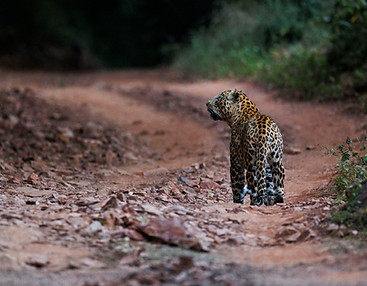
PANTHERA PARDUS
Leopard
Ranthambore is home to seven distinct species of wild cats. The Indian Leopard (Panthera pardus fusca) serves as an important co-predator in the hierarchy.
THE PLAN : ITINERARY
DAY 01: ARRIVAL & FIRST SAFARI
Arrive in Sawai Madhopur before noon and check into your hotel. Freshen up, enjoy lunch, and get ready for your first afternoon tiger safari. This will be your maiden venture into the magical forests of Ranthambore, your first real chance to step into the territory of the Royal Bengal Tiger.
Return to the hotel in the evening, enjoy dinner, and rest after an adventurous start to the tour.
DAY 02: MORNING & EVENING DRIVES
Today includes two safaris: one in the morning and one in the evening, inside the core tiger habitat. Along with the majestic Bengal tigers, you may encounter Indian leopards, sloth bears, sambar deer, chital (spotted deer), mugger crocodiles, and even freshwater turtles basking near the lakes. Experience the rich wildlife diversity that makes Ranthambore a paradise for nature lovers.
DAY 03: FULL DAY OF WILDLIFE EXPLORATION
Same schedule as Day 2, with morning and evening safaris, but this time you may enter a completely new zone of the park. Exploring a different zone adds excitement, as every area has its own landscapes, tiger territories, and unique wildlife activity. This gives you a wonderful chance to deepen your connection with the forest, discover new tiger movements, and witness fresh.
DAY 04: FINAL SAFARI & DEPARTURE
Head out for an early morning safari. After returning to the hotel, have breakfast, check out, and proceed toward the airport or your onward destination.
TRIP ENDS.
✓ 3 nights / 4 days at Ranthambore Tiger Reserve
✓ Twin-sharing stays in well-appointed lodges.
✓ All meals included (B, L, D)
✓ Guide and Photography skipper services.
✓ All safari permits and guide fees.

YOUR GUIDE IN THE FIELD
Pratik Pradhan is an internationally recognised nature and wildlife photographer who has spent over twenty years exploring and documenting India's wild spaces. From the dhonk forests of Ranthambhore to the cold, thin-aired ridgelines of Spiti. His photography blends natural history with fine art, built on a belief that patience and fieldcraft matter as much as gear.
Alongside his own photography, Pratik teaches through small-group photo tours and photography sessions, and extends a warm invitation to nature enthusiasts of every skill level to join him in the field.
With small group sizes, participants receive hands-on guidance in the field throughout the workshop, constructive feedback, and insights drawn from years in the field behind the camera.
More information about Pratik's work and services can be found on his website.


max 7 participants
3N-4D days
starting from
INR 72,500
per batch
per person
26th Nov to 03rd Dec, 2026 | SOLD OUT
04th to 07th Mar, and 20th to 23rd Mar, 2027 | BOOKINGS OPEN
Beyond the sighting lies the photograph
This is a small-group expedition, and once it's full, it's full. Pratik personally reviews every booking and responds to every enquiry. Reach out now and secure your spot.
PHOTOGALLERY


WHAT PEOPLE SAY ABOUT PRATIK


